
Lunch Program
Nutrition Services
Free Meals for Students, Plus Important Reminders for Families
We are excited to share that all students receive free lunch through the Healthy School Meals for All program! This statewide program, approved by Colorado voters, is helping Colorado children and teens have access to nutritious food at our school.
ECCA follow the elementary menu, and we don’t provide breakfast at this time.
CLICK HERE for an Economic Assistance Application (click here para en Español). Please forward completed applications to the ECCA Accounting Manager at businessmanager@eagleschools.net
Nutrition Services
Standard Operating Procedures
Kitchen Use
Access to kitchen/equipment must be approved by the Director of Nutrition Services, any kitchen use will require a nutrition services staff member be retained onsite for the duration of your events food service period at a rate of $30/hr. You will need to provide a budget code to cover the employee’s labor. Please reach out to our Area Operations Manager for the necessary paperwork.
“Healthy School Meals for All Program”
Beginning at the start of the 23-24 school year, all ECSD students have access to free school breakfast and lunch. This does not entitle students and schools to all benefits of the Free & Reduced program, and all parents are still encouraged to apply for that status.
Free & Reduced
Free & Reduced applications must be filled out every year. Prior year F&R statuses expire in September, please assist us in getting parents to fill out an application on our website. The October 1 count will be developed based on these approved applications, this could affect your ability to receive grants.
Student Negative Balance Policy
If a student runs out of money or incurs a debt, snacks and beverages cannot be purchased until the debt is settled. Weekly paper reminders will be sent home weekly, and we encourage parents to sign up for balance notifications at https://www.schoolcafe.com. Students will continue to receive a hot lunch and continue to accrue debt if the negative balance is not addressed promptly. Account balances can be viewed and payments can be made online at https://www.schoolcafe.com
Staff Negative Balance Policy
Staff are not able to carry a negative balance on their lunch accounts. If staff owes money or will go into debt, lunch and or ala carte snacks will not be sold to them.
“I just need a few”
It is not acceptable for staff to use utensils, napkins, condiments, or salad bars to supplement their lunch from home without purchasing the items. Parents should be encouraged to include appropriate supplements with their child’s lunch from home as well.
Field Trip/Sack lunch
A 14 day email notification and Sack Lunch Request Form must be provided to the kitchen manager in order to receive sack lunches for field trips. Failure to provide this information within a timely manner could result in us not being able to provide your students with a meal for your field trip.
Food Fundraising/Competitive Foods Policy
Due to legislation put in place from the Healthy Hunger Free Kids Act of 2010, Nutrition Services is required to approve any fundraiser for food items that can be consumed during school hours and up to 30 minutes before/after school ends. The exemption form can be found on our nutritional services page at https://www.eagleschools.net/departments/nutritional-services
All students will now receive free breakfast/ lunch during the school year but students can still take advantage of other More than a Meal benefits as listed below.
The application process begins on July 1. Please complete by September 25, 2025. Applications can be filled out at schoolcafe.com.
Benefits Include:
o Fee waivers for enrolled students
o Improved access for scholarships with our community partner programs
o Health and wellness services
o Fee waivers for college applications and admissions tests, and more
For any questions related to the program or to obtain a paper application contact nutrition services at 970.328.2760 (English) or 970.328.2758 (Spanish).
Below is a summary of our competitive foods policy regarding the sale of food on school campuses beyond the school meal program. Read the full Distribution and Sale of Competitive Foods Policy.
To request to sell food products, complete the Food Fundraiser – Exemption Sheet and return it to the Nutrition Services Department. For further information, please feel free to contact us at 970-328-2750.
- No consumable products, food and/or beverages, may be sold on a school campus by any individual or group during a school day without approval by the Nutrition Services Department of Eagle County Schools.
- This policy applies to fundraisers that are organized through student stores, culinary arts programs or by student clubs, parent groups, booster clubs, associated student body groups, teachers, students, or staff.
- A “school day” is defined as the period from midnight before through to 30 minutes after school.
- Application must be made and approved by the Director of Nutrition Services prior to the publication or sales of food and beverages.
- All food sold outside the school meal program, on the school campus, during the school day must meet, at a minimum, the nutrition standards set by Nutrition Services (see the full policy for details).
- Absolutely no food or beverages may be sold on a school campus during school meal programs (45 minutes prior through to 45 minutes after any scheduled breakfast or lunch). This includes any sales approved by the Nutrition Services Department.
- This policy included the distribution of free products and/or samples.
If your organization is interested in using our kitchen facilities for any reason, please reach out to our Area Operations Manager for more information.
Procedures for Cafeteria Meal Accounts
It is the responsibility of parents or guardians to prepay for school meals or pay for meals at the time of service; provide a breakfast or lunch from home; or complete an annual application establishing eligibility for free or reduced-price meals. Nutrition Services is unable to use state or federal funds to forgive student meal debts and has established guidelines to help families manage cafeteria accounts.
Families are encouraged to complete an application for Free or Reduced priced meal benefits anytime during the school year if they find their personal income situation has changed. Families are additionally encouraged to enroll in the online prepayment service www.schoolcafe.com for convenient online payments and account tracking. Reminders can be set up through the system to alert families when balances are low. It may take up to 24 hours to post the students account.
NOTE:
When a student’s account has a negative balance students will receive a courteous verbal communication with a negative balance slip to remind students and parents that the cafeteria account is in the negative. Students will also not be able to purchase A La Carte items.
When a student’s account is $6.00 or more in the negative the student will receive one or more of the following: a verbal reminder, a negative balance slip to bring home to the parent’s, a negative balance letter sent to parents/guardians, and a phone call to the student’s home.
Read this letter to parents before proceeding.
Dietary Disabilities – Forms
- Medical Statement for Meal Modification PDF
- Informe Médico para Modificación del Consumo de Alimentos PDF
Discontinuation of Meal Modifications – Forms
There are a few important differences between food intolerances and allergies. Knowing them can help you to manage your health and that of your family when discomfort arises from eating certain foods, even letting you know when it’s appropriate to consult a physician. For more information and resources, visit the Food Allergy & Anaphylaxis Network.
A food intolerance happens when you have trouble digesting certain ingredients, or they simply irritate your stomach. Lactose and food additive intolerances are the most common.
Food Intolerance:
- Usually comes on gradually.
- May only happen when you eat a lot of the food.
- May only happen if you eat the food often.
- Is not life-threatening.
- A food allergy occurs when your body has an immune reaction to the food you eat. If you have a food allergy, you’ll need to completely stop eating the trigger food. According to WebMD, 90% of allergies are caused by the following items: peanuts, tree nuts, fish, shellfish, milk, eggs, soy, and wheat. Celiac disease (gluten allergy) is a true allergy, though not life-threatening.
Food Allergy:
- Usually comes on suddenly.
- Small amount of food can trigger.
- Happens every time you eat the food.
- Can be life-threatening.
- While intolerances and allergies share a few symptoms, like nausea, stomach pain, diarrhea, and vomiting, only true allergies lead to rashes, shortness of breath, chest pain, or most seriously, a sudden drop in blood pressure and/or trouble swallowing or breathing. Only a doctor can determine if you have an intolerance or an allergy.
Agriculture/ Local/ Sustainable Foods
- Vail Farmer’s Market
- Edwards Farmer’s Market
- Minturn Farmer’s Market
- American Farmland Trust
- Center for Ecoliteracy
- Slow Food USA
Tips on Buying Fish and Seafood
For many, buying fish‚ especially fresh‚ can become a confusing chore: what are the best kinds? How can I tell if it’s truly fresh? What do I do with it? And as a result, they don’t get to enjoy the taste and health benefits of fish as much as they ought.
The most important thing to remember is that “fresh” used to mean from the water. Modern cold storage has changed everything. “Fresh” is now used for any seafood that has not been frozen. It’s important to pay attention to how long a fresh fish in the store has been around because the label ‚fresh‚ is not always an indication of fresh-from-the-water quality. On the other hand, all frozen or previously-frozen fish is not created equal; you may have concerns about sustainability and other farming methods. These questions will require a bit of sleuthing on the Internet on your part. Also, frozen fish should not have white or orange patches (signs of drying or rancidity, respectively).
In general, here are tips for choosing fresh fish and seafood:
- Fresh or Thawed Whole Fish: shiny skin; tight, flat scales; no strong‚ fishy odor; bright, clear eyes; and bright gills with little to no, slime.
- Fresh or Thawed Filets, Etc.: no strong‚ fishy odor; firm flesh; and no bruising, blood spots, or browning.
- Fresh or Thawed Shrimp: firm flesh completely filling the shell, no black edges or spots, no strong odor, and should not feel slippery.
- Live Lobsters or Crabs: leg movements, shells free of blotches or cracks, lobster tails curl under when picked up, and weight should seem heavy for the size.
- Live Oysters, Clams, or Mussels: hard, unbroken, tightly closed shells.
Is Sugar Toxic?
If you are what you eat, then what does it mean that the average American consumes 130 pounds of sugar a year? New research coming out of some of America’s most respected institutions is starting to find that sugar, the way many people are eating it today, is a toxin and could be a driving force behind some of this country’s leading killers, including heart disease [and cancer].
Excerpts from “Sugar” CBS News April 1, 2012
Dr. Robert Lustig, a California endocrinologist‚ believes the consumption of added sugars has plunged America into a public health crisis. Central to Dr. Lustig’s theory is that we used to get our fructose mostly in small amounts of fruit‚ which came loaded with fiber that slows absorption and consumption ‚ [but] as sugar and high fructose corn syrup became cheaper to refine and produce, we started gorging [to our detriment].
A groundbreaking, five-year study [out of University of California, Davis is already suggesting] that when a person consumes too much sweet stuff, the liver gets overloaded with fructose and converts some of it into fat. Some of that fat ends up in the bloodstream and helps generate a dangerous kind of cholesterol called small dense LDL. These particles are known to lodge in blood vessels, form plaque and are associated with heart attacks.
Lewis Cantley, a Harvard professor and the head of the Beth Israel Deaconess Cancer Center, says when we eat or drink sugar, it causes a sudden spike in the hormone insulin, which can serve as a catalyst to fuel certain types of cancers. What we’re beginning to learn is that insulin can cause adverse effects in the various tissues. And of particular concern is cancer. Nearly a third of some common cancers‚ including breast and colon cancers‚ have something called insulin receptors on their surface. Insulin binds to these receptors and signals the tumor to start consuming glucose.
[Finally, an] American Heart Association report [recommended] men should consume no more than 150 calories of added sugars a day. And women, just 100 calories. That’s less than the amount in just one can of soda.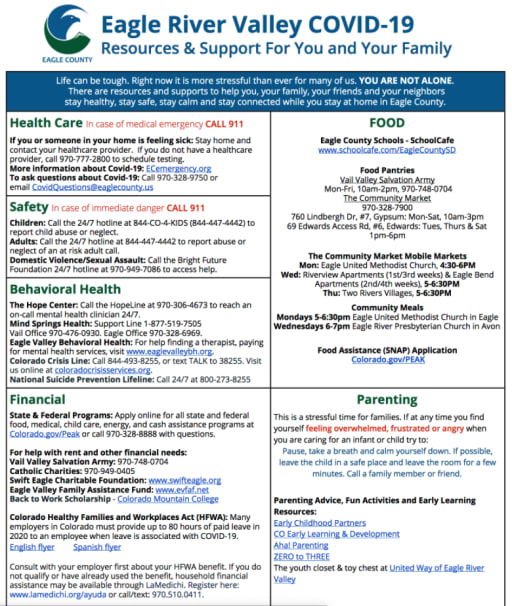

ECSD Wellness Committee
Health & Nutrition
Exercise & Fitness
-
School Food
- Colorado Department of Education School Nutrition Unit Website
- Colorado Department of Education School Breakfast Program Meal Patterns PDF
- Colorado Department of Education School Lunch Program Meal Patterns PDF
- Colorado Department of Education Summer Food Service Program Patterns PDF
Food Safety
- U.S. Department of Agriculture Nondiscrimination Statement – English
- Declaración de No-discriminación del USDA
- Civil Rights Complaint Procedure – English
- ECSD Non Discrimination/Equal Opportunity Policy PDF
- U.S. Department of Agriculture Discrimination Complaint Form PDF
- ECSD Complaint Procedure Policy PDF


